
The Duality by Margaret Atwood on Freedom, Power, and the Female Experience.
August 29, 2026 Share: Home/Life/Culture/Why You Should Read “The Handmaid’s Tale” and “The Testaments”
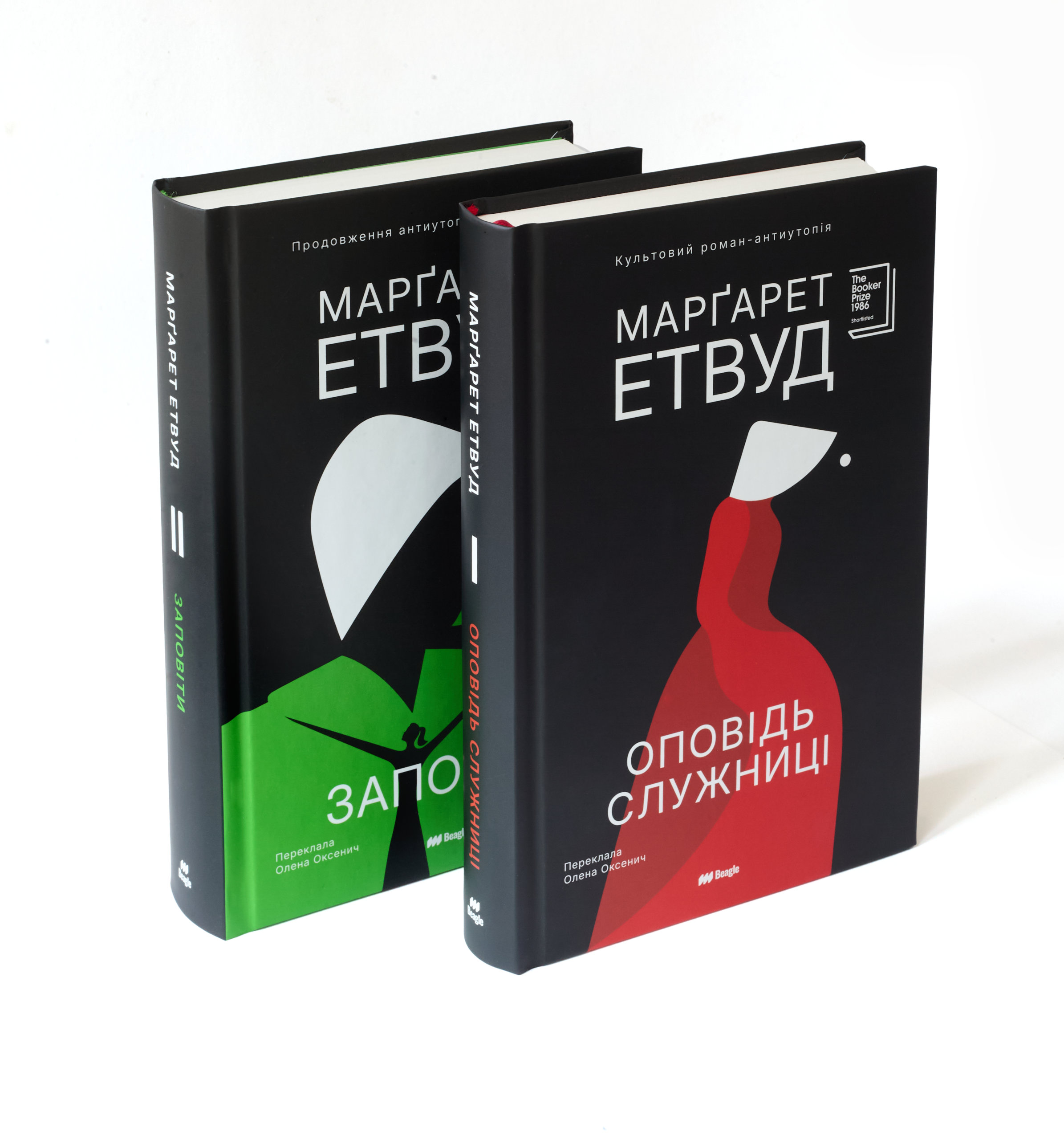
Beagle Publishing is reintroducing Ukrainian readers to Margaret Atwood’s iconic duality – “The Handmaid’s Tale” and its sequel, the Booker Prize winner “The Testaments.” The books are being released simultaneously, offering an excellent opportunity to rediscover the narrative after watching the Hulu series or to read both novels for the first time as a cohesive story about female freedom and the ruthlessness of power. In this article, we explore Gilead and why this duality has become so influential in the feminist movement, literature, and political processes.
The Flow of “The Handmaid’s Tale” Novel
“The Handmaid’s Tale” was published in 1985, but the word “Gilead” has long transformed into a cultural code used to describe state-sanctioned violence against women. The novel is still taught in universities, cited in court rulings, and referenced in discussions about reproductive rights worldwide. It has enriched the language used to describe violations of women’s bodies with precise and recognizable imagery: “reds” – the handmaids, “blues” – the wives, “Aunts,” and the “Ceremony.” This is a rare instance where a work of fiction has become a practical tool for describing violence.
The most striking example is the ruling by Judge Robert McBurney of the Fulton County Superior Court in Georgia, who in 2024 struck down a law banning abortions after the detection of a heartbeat, stating:
“It is not for the legislature, the judiciary, or a Commander from ‘The Handmaid’s Tale’ to decide what these women do with their bodies.”
However, the victory was short-lived: a week later, the state Supreme Court reinstated the ban pending appeal. The phrase about “a Commander from The Handmaid’s Tale” had already entered legal discourse and outlived the decision that prompted its emergence.
Atwood’s novel has also become a shared code for the language of political protest. When a draft Supreme Court decision to overturn the law legalizing abortion leaked online in the spring of 2022, Congressman Jamie Raskin publicly warned that the logic of this draft opened the door to legislation “in the spirit of ‘The Handmaid’s Tale’.” Atwood herself responded with an essay in The Atlantic, drawing parallels between the court’s arguments and the way Gilead’s power is constructed. The imagery from the novel and the series – red cloaks, white bonnets – regularly appears as a form of protest during Congressional hearings, particularly during the confirmation of Supreme Court justices.
Relevance Today
Political analysis and street protest are processes of different weight. Both demonstrate the novel’s rare ability to serve as a common language for lawyers, politicians, and activists.
This ability is embedded in the very concept and mechanisms of Gilead’s power. The duality unfolds in a territory where a theocratic state emerged after a military coup. A sharp decline in birth rates – a consequence of an ecological catastrophe – became the new regime’s “rational” pretext to enslave fertile women. Thus, in “The Handmaid’s Tale” and “The Testaments,” Atwood portrays a society where individuals are reduced to mere functions. The protagonist, Offred, exists as a reproductive resource for the regime, not as a person. It is this reduction of a human being to a role that makes the novel simultaneously so chilling and enduring. It functions as a diagnosis of the mechanism by which totalitarian systems appropriate a woman’s body, language, and memory, always finding justifications for violence that masquerade as necessity.
“The Handmaid’s Tale” offers a perspective from the position of someone deprived of her voice. It is a story about how quickly rights that seemed inviolable can crumble and how imperceptibly a totalitarian mechanism can integrate into everyday life.
“The Testaments”
“The Testaments,” on the other hand, offers a view from within the system, told through three female voices: one of Gilead’s influential figures and two young women who grew up on different sides of its borders. Here, strong female leadership emerges in all its complexity – from complicity in the regime’s crimes to underground struggles for its destruction. “The Testaments” provides a sense of closure and hope: any tyranny – even one that appears entirely stable – has internal cracks. It is through these that the system eventually collapses – thanks to a network of small, often unnoticed acts of defiance.
Together, the two novels form a complete cycle of the story: the birth of a system of violence – and its destruction by the very women it sought to silence. The duality remains so relevant today because it describes the universal grammar of power: how regimes justify violence through “security” and “tradition,” how language becomes a tool of control – and how true resistance can begin with small actions that ultimately provoke the system’s downfall.
Beagle Publishing has presented the story as Atwood intended: as one complete narrative about the origins of tyranny and the resistance that is born within. The duality can be purchased in bookstores or listened to as audiobooks on the platforms Yakaboo, Megogo Books, Readeat, and Librarius. Both books are narrated by actress Nadiya Khilska, who works in theatre, film, and dubbing.